Showing posts with label Non-Fiction. Show all posts

Friday, 8 November 2013

Hyperbole and a Half

Title: Hyperbole and a Half
Author: Allie Brosh
Pages: 369 (paperback)
Published: October 29th 2013
Published by: Touchstone


In a four-color, illustrated collection of stories and essays, Allie Brosh’s debut Hyperbole and a Half chronicles the many “learning experiences” Brosh has endured as a result of her own character flaws, and the horrible experiences that other people have had to endure because she was such a terrible child. Possibly the worst child. For example, one time she ate an entire cake just to spite her mother.

Brosh’s website receives millions of unique visitors a month and hundreds of thousands of visitors a day. This amalgamation of new material and reader favorites from Brosh's blog includes stories about her rambunctious childhood; the highs and mostly lows of owning a smart, neurotic dog and a mentally challenged one; and moving, honest, and darkly comic essays tackling her struggles with depression and anxiety, among other anecdotes from Brosh's life. Artful, poignant, and uproarious, Brosh’s self-reflections have already captured the hearts of countless readers and her book is one that fans and newcomers alike will treasure.


So just take a moment to scroll down this page a little bit. On the left, you'll find a list of blogs I read. Most of them belong to authors I love, but there is one that stands out as truly different. It's called Hyperbole and a Half and it is truly and honestly the most hilarious blog I have ever read. And quite possibly on the entire internet in general. Go and have a look at it. There are a plethora of posts to read. Spaghatta Nadle and its follow-ups are particular favourites of mine. Why? I have no idea. They just are.

This is the book of the blog, by the rib-achingly funny Allie Brosh, chronicling some of the many mis-adventures of her life, a tutorial for dogs and an amusing/heartbreaking account of her experience with depression. This full title is in fact Hyperbole and a Half: Unfortunate Situations, Flawed Coping Mechanisms, Mayhem, and Other Things That Happened, which sums up everything it contains pretty well.

Some of the stories in this book are new, and some have been taken from the blog. I thoroughly enjoyed all of them and look forward to many re-reads in the future. Even the one's I read before often had me laughing out load. Actually laughing out loud. Not like when you're like 'lol' and it maybe made you smirk a little bit.

Read this book. And the blog. Because they're amazing, and pretty much speak for themselves on this front. Seriously, what are you still doing here? Go!


Friday, 30 August 2013

HHhH

Title: HHhH
Author: Laurent Binet
Translator: Sam Taylor
Pages: 384
Published: May 23rd 2012 (first published 2010)
Published by: Harvill Secker

Everyone has heard of Reinhard Heydrich, “the Butcher of Prague.” And most have heard stories of his spectacular assassination at the hands of two Czechoslovakian partisans. But who exactly were the forgotten heroes who killed one of history’s most notorious men? In Laurent Binet’s captivating debut novel, HHhH (Himmlers Hirn heiBt Heydrich, or Himmler’s brain is called Heydrich), we follow the lives of Jozef Gabcik and Jan Kubiš, the Slovak and the Czech responsible for Heydrich’s death. From their heroic escape from Nazi-occupied Prague to their recruitment by the British secret services; from their meticulous preparation and training to their harrowing parachute drop into a war zone; from their stealth attack on Heydrich’s car to their own brutal deaths in the basement of a Prague church, Binet narrates the compelling story of these two incredible men, rescuing their heroic acts from obscurity. The winner of the prestigious Prix Goncourt du Premier Roman, Binet’s HHhH is a novel unlike anything else. A seemingly effortless blend of historical truth, personal memory, and Binet’s remarkable imagination, HHhH is a work at once thrilling and deeply engrossing—a historical novel and a profound meditation on the nature of writing and the debt we owe to history.

HHhH - Himmler's Hirn heisst Heydrich - Himmler's brain is called Heydrich

This book accounts the run-up-to and assassination of Reinhard Heydrich, including his rise through the Nazi party and the movements of his killers in the days and months preceding his death. Unfortunately, there are quite regular insertions by the author about the research he is doing, the things he has come across and even random asides from his personal life. It was these sections that negatively affected my opinion of this book. It broke the flow of the reason I was reading the book and while it well served to show the passion of Binet on this subject, for me that came through enough in the level of detail in regards to the historical events without him needing to constantly show it in other ways.

Without a doubt this is a well researched book and Binet doesn't include anything without being able to verify it as fact. Or rather, the times he does invent details or conversations he tells us about it. This is good in terms of accuracy, but not quite what I was expecting (though re-reading the blurb, maybe should have been), expecting something more like Schindler's List where the events are expanded upon with likely conversations. Two different approaches, each with their benefits. On the flip side, it does mean we are party to a short chapter on a comment made about the inclusion of an imagined detail. This comment made him remove a certain phrase, then search for something to replace it, and eventually put it back in. I've never felt the need to know anything about an author's personal editing process before. And in all honesty I could have lived perfectly without it this time.

Things like this aside, I found Binet's writing easy to read, something that can be difficult when it comes to subjects like this. Yes, there isn't mass-murder on every page or anything like that, but because of this it isn't exactly the most scintillating of things to read at times, but I never felt bored by what was going on or anything. There are also the random asides - not about himself - about other things that went on during the period covered. Most of them are at least vaguely related, but sometimes wonderful little stories make their way into the book simply because they're wonderful. Which is pretty heart-warming.

An interesting read for those who want to find out more about the life and death of the Butcher of Prague and those who killed him.

And suffered the reprisals.


Saturday, 5 January 2013

Watching the English

Title: Watching the English: The Hidden Rules of English Behaviour
Author: Kate Fox
Pages: 432 (paperback)
Published: April 11th 2005
Published by: Hodder and Stoughton


In "Watching The English" anthropologist Kate Fox takes a revealing look at the quirks, habits and foibles of the English people. She puts the English national character under her anthropological microscope, and finds a strange and fascinating culture, governed by complex sets of unspoken rules and byzantine codes of behaviour. The rules of weather-speak. The ironic-gnome rule. The reflex apology rule. The paranoid-pantomime rule. Class indicators and class anxiety tests. The money-talk taboo and many more ...


Through a mixture of anthropological analysis and her own unorthodox experiments (using herself as a reluctant guinea-pig), Kate Fox discovers what these unwritten behaviour codes tell us about Englishness.


Starting off, I loved this book. It was generally well-written, easy to read, insightful and funny. Yes, I was mainly laughing at all the things I recognised that I did myself, but it was still funny. These were things I didn't even really notice, or rather didn't realise were peculiarly English (I almost wrote British there, but the book is exclusively about the English!The Scots, Welsh and Irish would probably hate to be lumped in with us). The topics were interesting and easy to relate to - things you see all the time and think nothing off. It's just the way you, or others act; it's the norm. I can't imagine how hard it must have been for Fox to remove herself from her own culture and get inside of it.

But then the chapters started getting longer. And longer.

And the time it took me to read each one got longer. And longer.

Even though each chapter has subsections (often very similar ones), it is still rather disheartening to have been reading for half an hour and still only be half-way through a 50-page chapter. I think this book would have benefited from being broken down into more bite-sized chunks. The early chapters were easy to wizz through in a sitting, and I enjoyed them a lot more like that.

There was also rather a lot of repetition. I understand that she's looking for the commonalities of English-ness in various aspects of everyday life and therefore the same things will keep cropping up, but 'social dis-ease' and 'props and facilitators' came up so often it began to annoy me a little. Similarly when it came to class and the endless lists and repetitions of what the lower/lower-middle/middle-middle/upper-middle/upper class would do in each circumstance, call each thing. Towards the end even the author made a joke about how often these had been referenced, and couldn't we work it out for ourselves by now?

In all honesty I skipped over the conclusion section. I'd read the little summary at the end of each chapter and figured this would just be a general gathering of everything said there. I scanned and skipped bits, but nothing more. Because I couldn't be bothered reading the same things all over again.

This book was quite interesting in places, but could have been written more concisely I think. Being English, I appreciated it, but I doubt people from other nationalities would unless they had spent a lot of time in England or around the English.


----
Some of my favourite quotes from the book:

"Formality is embarrassing. But then, informality is embarrassing. Everything is embarrassing." (p. 41)

"If you are socially skilled, or come from a country where these matters are handled in a more reasonable, straightforward manner (such as anywhere else on the planet), you may need a bit of practice to achieve the required degree of embarrassed, stilted incompetence." (p. 52)

"English men can turn almost any conversation, on any topic, into a Mine's Better Than Yours game." (p. 55)

"[T]he English...can spot the slightest hint of self-importance at twenty paces, even on a grainy television picture and in a language we don't understand." (p. 63)

"When waiting alone for a bus or at a taxi stop, I do not just lounge about anywhere roughly within striking distance of the stop, as people do in other countries - I stand directly under the sign, facing in the correct direction, exactly as though I were at the head of a queue. I form an orderly queue of one." (p. 91)

"I would suggest that home is what the English have instead of social skills." (p. 134)

"The opportunity to moan or, even better, the opportunity to indulge in some witty moaning, is irresistible." (p. 143)

"...when any inadvertent, undesired contact occurs (and to the English, almost any contact is by definition undesired), we say 'sorry'." (p. 150)

"We huff and puff and scowl and mutter and seethe with righteous indignation, but only rarely do we actually speak up and tell the jumper to go to the back of the queue." (p. 154)

"Moderation is all very well, but only in moderation." (p. 195)

"...the English take great pleasure in being shocked and outraged, and righteous indignation is one of our favourite national pastimes" (p.196)

"The English are human; we are social animals just like all other humans, but we have to trick ourselves into social interaction and bonding by disguising it as something else" (p. 241)

"The English are not keen on random, unstructured, spontaneous, street-corner sociability; we are no good at this, and it makes us uneasy. We prefer to socialize in an organised, ordered manner, at specific times and places of our choosing, with rules that we can argue about, an agenda, minutes and a monthly newsletter." (p. 250-251)

"Even an Anarchist meeting I attended followed the same sequence, although it was much better organized than most, and at the demonstration the next day the members were all dressed in uniform black, carrying professional looking banners, chanting in unison and marching in step." (p. 252-253)

"...our obnoxiousnesses are about as awkward, irrational and inelegant as our politenesses." (p. 265)

"'I get the impression,' said one frustrated American, 'that at some deep-down, fundamental level the English just don't really expect things to work properly" (p. 303) *We don't. It's more surprising when things go right than when they go wrong.

"At funerals we are left bereft and helpless. No irony! No mockery! No teasing! No banter! No humorous understatement! No jokey wordplay or double entendres! How the hell are we supposed to communicate?" (p. 375)

Monday, 2 July 2012

The Psychopath Test

Title: The Psychopath Test: A Journey Through the Madness Industry
Author: Jon Ronson
Pages: 293 (paperback)
Published: June 3rd 2011
Published by: Picador


This is a story about madness. It all starts when journalist Jon Ronson is contacted by a leading neurologist. She and several colleagues have recently received a cryptically puzzling book in the mail, and Jon is challenged to solve the mystery behind it. As he searches for the answer, Jon soon finds himself, unexpectedly, on an utterly compelling and often unbelievable adventure into the world of madness. 

Jon meets a Broadmoor inmate who swears he faked a mental disorder to get a lighter sentence but is now stuck there, with nobody believing he’s sane. He meets some of the people who catalogue mental illness, and those who vehemently oppose them. He meets the influential psychologist who developed the industry standard Psychopath Test and who is convinced that many important CEOs and politicians are in fact psychopaths. Jon learns from him how to ferret out these high-flying psychopaths and, armed with his new psychopath-spotting abilities, heads into the corridors of power... 
Combining Jon’s trademark humour, charm and investigative incision, The Psychopath Test is a deeply honest book unearthing dangerous truths and asking serious questions about how we define normality in a world where we are increasingly judged by our maddest edges.


Psychology is a huge subject, and even though I spent three years studying it at university, psychopathy was one thing we never even touched on (to the best of my recollection at any rate...) which is a shame because it's an incredibly interesting topic. That there are people for whom their emotional reactions to others just don't work the same as in other people.

This book doesn't start out as being about psychopathy, but about a number of academics who received a strange book in the mail. When Jon Ronson is brought in to try and work out how it came from and why, it sets him off on a path that will lead him to many interesting people and places - because for it's a little disturbing, psychopathy is to me undoubtedly interesting. He learns about, and discloses, Bob Hare's checklist for finding psychopaths and while I don't know anyone who particularly stands out in any of the ways put forward there, it is definitely something I'll be on the lookout for in the future. He then moves on to thinking about madness in general and the place it has in society today, and there are definitely some interesting conclusions reached in the course of his research and the people he meets.

Ronson is a very good writing - not surprising considering that he's a journalist - and he quite easily engages you, weaving smaller side stories throughout the narrative of his journey through the madness industry. Still, I've got to say I think the earlier part of the book was better than the later purely because of the subject matter. I found the strictly psychopathy parts more interesting than the more general madness parts, even though the overall subject is still the same. He also manages to bring humour in, and I quite often found myself snickering at the thoughts he has, or the things he says and the way people react.

He is concise, and you never feel bogged down in any details of anything, but neither are you left confused. Yes, I have some background to the whole 'psychology' thing, but I've probably forgotten most of what I ever knew, and I didn't think there was anything that would have confused someone who didn't know anything about the subject. Ronson has obviously done his research very well and knows what he's talking about.

A good and interesting book with a good insight into something which few people probably really know anything about.


Wednesday, 6 June 2012

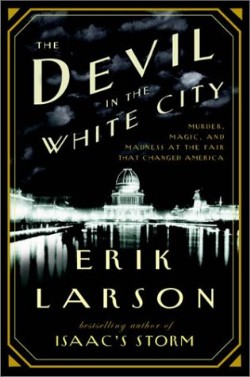
The Devil in the White City

Title: The Devil in the White City: Murder, Magic, and Madness at the Fair that Changed America.
Author: Erik Larson
Pages: 464 (paperback)
Published: February 10th 2004
Published by: Knopf Doubleday Publishing Group

Author Erik Larson imbues the incredible events surrounding the 1893 Chicago World's Fair with such drama that readers may find themselves checking the book's categorization to be sure that 'The Devil in the White City' is not, in fact, a highly imaginative novel. Larson tells the stories of two men: Daniel H. Burnham, the architect responsible for the fair's construction, and H.H. Holmes, a serial killer masquerading as a charming doctor. Burnham's challenge was immense. In a short period of time, he was forced to overcome the death of his partner and numerous other obstacles to construct the famous "White City" around which the fair was built. His efforts to complete the project, and the fair's incredible success, are skillfully related along with entertaining appearances by such notables as Buffalo Bill Cody, Susan B. Anthony, and Thomas Edison. The activities of the sinister Dr. Holmes, who is believed to be responsible for scores of murders around the time of the fair, are equally remarkable. He devised and erected the World's Fair Hotel, complete with crematorium and gas chamber, near the fairgrounds and used the event as well as his own charismatic personality to lure victims. Combining the stories of an architect and a killer in one book, mostly in alternating chapters, seems like an odd choice but it works. The magical appeal and horrifying dark side of 19th-century Chicago are both revealed through Larson's skillful writing.

Daniel Burnham and H. H. Holmes are two men who took advantage of Chicago winning the prestigious rights to hold a World's Fair. One was an architect who was determined that the event would beat the Paris Exposition a number of years before and who pushed himself and everyone around him to achieve this. The other was a serial killer who took advantage of the many people who visited the fair alone, using his charm and charisma as a mask to his psychopathy and as a way to slake his thirst for death. Two very different men, but their stories are interwoven into this book.

I don't read many non-fiction books, and I when I do they tend to be more psychology-based. While one could argue that the whole 'psychopath serial killer' thing is rather psychological, this isn't really the focus. Given that much of what it is thought Holmes did is based on speculation rather than fact you never really get inside his head at all. In spite of this being somewhat outside my normal reading I really enjoyed this book. Larson has obviously done his research - and done it very well - but also manages to put it on the page in a way that is both informative, interesting and (most importantly) engaging. While still not exactly a book I could sit and read for hours at a time, I could quite happily sit and read a number of chapters in a go.

This is achieved in part because of the interweaving of stories throughout, all essential to the fair and the events which transpired. Burnham and Holmes are the main focus, but there are other people who were equally important which get their share of the page-time. A couple were quite random and you didn't really see how they'd have any impact until they did. But there were also just stories of the fair from regular people who had no impact on the larger picture. Couples meeting at the fair and small follow-ups to their lives, what people thought of various things and those who would later became famous (various future Presidents cropped up, and Mark Twain went to Chicago but never made it to the fair) or were related to famous names (Walt Disney's father worked there). The narrative does a great job of showing just how much of an impact this fair had on America and it's people.

While there isn't any mystery to Holmes' true nature it is interesting seeing how he interacts with people and how his psychopathy evolves over time. He is an incredibly charming and disarming man, and there are many accounts of him defusing difficult situations, be they financial or when someone comes looking for missing people, with the greatest of ease. Without a doubt inventive, he is something of a criminal master-mind and very adept at hiding his killing, to the point where no one can really even guess as to how many victims he had.

Burnham and the building of the fair is interesting in a whole different way as you see the fight he had to become an architect, to win the necessary people over to the cause, and then navigate all the bureaucracy to achieve the vision he had of this magnificent event. He fights incredibly hard all the way and refuses to give up on what he wants, which is true of a number of other people involved in the build. The other that stands out is a young engineer who had an idea to top that of the Eiffel Tower (the centre-piece of the Paris Exposition) who had to fight to have others believe it was something that was achievable...but I won't spoil who he was or what he built for those, like me, who don't already know.

I went into this knowing absolutely nothing about the World's Fair in Chicago, and have come out wishing I was alive to see it thanks to the picture painted here. It sounds amazing, and this book does both it and the darkness in Holmes justice. Well worth a read.