Showing posts with label Dystopian. Show all posts

Friday, 21 June 2013

Wool Series

Title: Wool Omnibus (#1-5)
Series: Wool #1
Author: Hugh Howey
Pages: 509 (paperback)
Published: March 12th 2013
Published by: Simon & Schuster

In a ruined and toxic landscape, a community exists in a giant silo underground, hundreds of stories deep. There, men and women live in a society full of regulations they believe are meant to protect them. Sheriff Holston, who has unwaveringly upheld the silo’s rules for years, unexpectedly breaks the greatest taboo of all: He asks to go outside. His fateful decision unleashes a drastic series of events. An unlikely candidate is appointed to replace him: Juliette, a mechanic with no training in law, whose special knack is fixing machines. Now Juliette is about to be entrusted with fixing her silo, and she will soon learn just how badly her world is broken. The silo is about to confront what its history has only hinted about and its inhabitants have never dared to whisper. Uprising.

The world has gone to pot, and what remains of humanity resides within a silo: a self-sufficient tower with all they need to survive. Including a window onto the outside, so they can always see the corrosion of the planet due to the toxic atmosphere. The very worst crimes are punishable by cleaning: being sent outside to clean the camera lenses which give them this picture, shortly followed by certain death in spite of the protective suits they are given.

I've already covered the first three parts of this book, back when they were available as stand-alone ebooks. Now, like 18 months later, the paperback is finally available with all five compiled together in this omnibus edition and I got around to both purchasing and reading it.

And it was well worth both the wait and the read. At the end of the third section there is quite a major revelation, and development in the storyline. This left me hooked and wanting to know what happened next, and while the fourth section did not leave me wanting, it was probably my least favourite out of the five. The first three are setting the scene, pulling you into the mystery of what exactly is going on, what all these people discover, and then comes the reveal. The fourth serves somewhat as what is usually the middle book in a trilogy: the set-up for the grand finale after the hook. It's still very readable, but it felt like a lot went on without anything actually really happening.

Part of this is because of the points of view we see the story from. They aren't in the middle of the action, for various reasons, so we hear about the major things going on rather than experiencing them for ourselves firsthand. There are a couple of exceptions to this, and these were some of the best parts.

This continues into the fifth part somewhat, but is remedied by more action being taken by those we are following. The first two chapters in particular were wonderful in my opinion, showing just how good of a writer Howey is, not just at coming up with the cool ideas but in terms of emotive writing. I'll leave you hanging as to what actually happens, but I thought it was wonderfully done.

As the end to the first part of what is now going to be a trilogy of books (parts 1 to 5 being put together into this, the first book) it was a satisfactory ending with most of the things brought out over the course of the five stories being closed off nicely, but at the same time certain things are left so you're wondering just what will happen to the silo and the people inside it with all this new-found knowledge and the convictions of those now in charge.

I'll definitely be continuing with the series - a great example of indie writing come good.


Friday, 5 April 2013

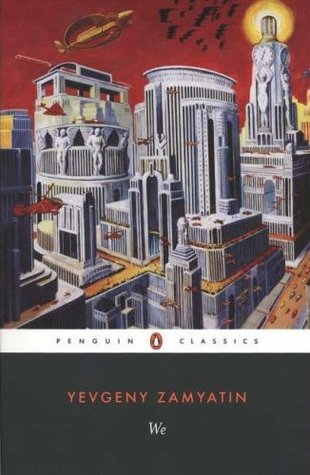
We

Title: We
Author: Yevgeny Zamyatin
Translator: Clarence Brown
Pages: 230 (ebook)
Published: 1921
Published by: ENC Press


The first dystopia ever, it started asking uncomfortable questions about individuals, collectives, revolutions, progress — and the collectives’ rights to individuals’ souls in the name of revolutions and progress.

Digit D-503 is a proud and happy citizen of the United Nation, where people live in identical glass houses and think identical transparent thoughts, equal among themselves and equally happy to be cogs in the machine of the most perfect society that ever existed on earth. The designer of the Integral, the United Nation’s first spaceship, meant to carry “mathematically error-free” happiness to other forms of intelligent life “possibly still existing in the primitive state of freedom,” D-503 is a True Believer in the path of the United Nation until he is mugged by reality that comes in the guise of love for a beautiful, cynical woman who rejects state-sponsored happiness and delights in leading a rebellion.

Yet the rebels’ only virtue is their rejection of the authority of the Do-Gooder, the annually unanimously reelected leader of the United Nation. Their revolution is but for its own sake, and their attitude toward “human slivers” is just as utilitarian as that of the United Nation: to either group, an individual life’s worth is measured only by its usefulness to the cause.


In this, the first dystopian novel and the influence for so many great others, the reader follows D-503. He is one among a collective, doing as he is told and as is set out for him, question nothing and perfectly content in his same-ness. He is the architect of the Integral, the first spaceship, designed to begin to take this perfect, regimented, organised way of life to the rest of the universe. It is only when he meets the captivating I-330 that he begins to stray from the way set out for him and realise that it might not be as perfect as he had previously thought. We are reading his journal, something he intends to be taken on the Integral as an educational tool for those civilisations they meet and 'educate'.

Written in 1921, this is a truly revolutionary book, and you can see its influence on many other books out there, 1984 particularly springing to mind with the regimented schedule and institute of watchful agents. The world created is one that is believable, and numerous times D- states how much better their world is than ours, how misguided we were thinking that things like democracy and personal freedoms made our lives better. How integrated people are, and how some people eventually begin to rebel, are both well done, and I particularly liked was the struggle that D- went through. He didn't just jump on board with the rebellion, there was true personal struggle and realistically human indecision and fear of the unknown. He is, after all, someone who has been one of many for all his life and never really had to think for himself or make any real decision.

There are a small core of characters, but it is only really three that you get any sense of feeling for: D-503, I-330 and O-90, she being D-'s lover at the start of the story. Others flit in and out, but you never really get to know them, and even these three there's a limit to how much you get to know them in that the regimented nature of their lives limits their ability to actually develop into individuals as much as they would have done otherwise. Even the rebellious I- is only really different in her rebellion: she does things because she's not supposed to; you don't really get the feeling she's doing things she likes. D- is clearly very intelligent and seems like a nice enough character, but as the narrator you don't get to see him that much, even if he is rather perceptive when it comes to others.

O-90 is possibly the character I was most attached to. She doesn't get huge amounts of page time, but she seems the most human of the characters we meet. The emotional journey she goes through is wonderfully evocative, and totally relatable. You can't help but feel for her and everything she goes through in the course of the story.

The story itself wasn't particularly gripping, but it was interesting seeing this world and how it's been put together, especially the 'vote' for the Do-Gooder, the unanimously re-elected leader of the United Nations (I pretty much always misread this, and had to go back to prevent confusion, minor though the difference is). It was a slow build, and the climax wasn't particularly climactic, but I still enjoyed the story and the changes D-503 and the United Nation goes through, for all that goes on does have a lasting impact. And the end, too, was realistic and an outcome that - given what you know of the system - makes sense.

An easily recommendable book, both for its own merits and as a look at the beginning of a genre which is coming more and more to the fore.


Friday, 8 February 2013

Battle Royale

Title: Battle Royale
Author: Koushun Takami
Translator: Yugi Oniki
Pages: 617 (paperback)
Published: February 26th 2003 (originally published 1999)
Published by: VIZ, LLC

Koushun Takami's notorious high-octane thriller is based on an irresistible premise: a class of junior high school students is taken to a deserted island where, as part of a ruthless authoritarian program, they are provided arms and forced to kill one another until only one survivor is left standing. Criticized as violent exploitation when first published in Japan - where it then proceeded to become a runaway bestseller - Battle Royale is a Lord of the Flies for the 21st century, a potent allegory of what it means to be young and (barely) alive in a dog-eat-dog world. Made into a controversial hit movie of the same name, Battle Royale is already a contemporary Japanese pulp classic, now available for the first time in the English language.


A class of school children and put on a island and told to kill each other off until there is only one person left alive: it's kill or be killed. They are each given a weapon, ranging from incredibly useful (a machine gun) to completely useless (a fork). How do you trust people in this situation? Even those you've been friends with for you whole life?

Whilst this isn't a book I think I'll ever read again I'm so glad I have read it once, because I was almost put off by the level of violence I was told was in it. This is a violent book, and sometimes a little unnecessarily so, but not to the level I was expecting from what I'd heard. I'm quite a squeamish person and there were a couple of bits that I struggled with but it wasn't too bad for the most part.

This was my first foray into Japanese literature and the style was a little unusual in places and I found myself actually laughing, somewhat inappropriately I'm sure, at some of the things in the narration. I also had trouble keeping track of who was who because I'm unfamiliar with the names and some of them were so similar, which I'm sure took something from the story. I'd be there trying to figure out who was who when two people ran into each other which was a little distracting at times but more a reflection of my inability than an actual criticism of the book.

As a psychology student, I found this book incredibly interesting as a study of human nature and how different people react in extremem situations. Obviously there are some who take to it like a fish to water; those who do what they need to simply to survive; and those who simply refuse to partake: the whole range is covered in this book in a great way. Confusion, fear and mistrust reign on the island, and make for a riveting read. People are second-guessing themselves and those they think they know and whole relationships fall apart right in front of your eyes, whilst others stand the test.There were also moments which were absolutely heart-breaking when tearful goodbyes were made.

Relatedly, the number of characters who claimed to love one of the others was just ridiculous! This may be a cultural thing which I'm missing, but it seemed like ever other person was in love with someone and for me that cheapened the emotion a little because I didn't believe it: they are only 15 and declarations of love are being made all over the spot. It seemed like a device to make the events more harrowing rather than a realistic reflection of that age group. One of the characters does wonder whether the situation is the cause of this which is possible, but so many seem to have been in love with the other person before 'The Program' began that I'm not sure of this.

The ending was a little obvious, though having said this there were genuinely incredibly tense times where I actually questioned whether I was right in my prediction which was wonderful. So often you never feel that the main characters are never in any real amount of danger; not so in this book, and for good reason!

Overall an amazing, fast-paced book that keeps you guessing and hoping and reading right to the very end.

Saturday, 25 August 2012

Wool Series

Titles: Wool; Proper Gauge; Casting Off
Series: Wool #1-3
Author: Hugh Howey
Pages: 298 total (ebook)
Published: July/November/December 2011
Published by: Broad Reach Publishing

Blurb from the omnibus edition (Wool #1-5)
This is the story of mankind clawing for survival, of mankind on the edge. The world outside has grown unkind, the view of it limited, talk of it forbidden. But there are always those who hope, who dream. These are the dangerous people, the residents who infect others with their optimism. Their punishment is simple. They are given the very thing they profess to want: They are allowed outside.

The world has gone to pot, and what remains of humanity resides within a silo: a self-sufficient tower with all they need to survive. Including a window onto the outside, so they can always see the corrosion of the planet due to the toxic atmosphere. The very worst crimes are punishable by cleaning: being sent outside to clean the camera lenses which give them this picture, shortly followed by certain death in spite of the protective suits they are given.

I'll hold my hands up and admit that I started reading this series because they were free ebooks. What's not to like about that? Free stuff is always good! It gives me a chance to explore new authors, and if I don't like them it doesn't even matter 'cos it doesn't cost a thing - a win/win situation the way I see it. But this series is definitely an overall win: I've read the three books over the past two and a half months and thoroughly enjoyed each one of them.

They all follow a separate character, but the progression from character to character makes sense, and all follows and continues the thread of the same story. They each have a distinct voice and move the story forwards in their own way, slowly showing you something of the extent of the corruption within the silo.

First is Holston, the sheriff of the silo. His story unfolds both the present day, and with flashbacks to three years earlier when his wife had gone crazy and demanded to be let outside. The descriptions of life within the silo are well done, and you aren't overloaded with details being thrown at you. They're slipped in naturally in the narrative, and you build up a picture throughout each of the books. By the end of the book, you find out what caused his wife's actions, and come to a shocking realisation about the internal workings of the silo.

Book two picks up right after, this time with Mayor Jahns providing the story. She and the deputy sheriff - Marnes - set off on a journey down the depth of the silo, right to the Mech levels right at the very bottom. This one has more of an information-y feel, giving you more about the functioning of the silo and the power struggles, as well as more clues to the underlying conspiracy. Complete with another shock ending, you are slowly pulled more and more into this world.

The third book followed Juliette as she tries to adjust to life on the top levels after spending decades down in the Mech level. She understands machines, not people, but the analogies she draws between the two are wonderful. Her journey is probably my favourite thus far and I really like her character. She's smart, and quickly gets to grips with the things she needs to, even when thrown in a little at the deep end. The end of this book is the most gripping of the three, and I'm incredibly interested to see what happens in the next book.

Howey has created a wonderfully unique voice for each character, the life they've lived tinting the way they think, the way they see and understand the world and those around them. The silo is well thought out, though the world-building is limited, namely because of the limitations of the whole world being confined to a tower. The plot doesn't really suffer because of this, though. It's interesting and goes along at a good pace. Each book is longer than the last (70, 107 and 122 pages respectively), so each story arc is given more time to develop as you learn more.

Obviously, you know things that the characters in books 2 and 3 don't know - you've followed the progression of events and are party to things that they just can't know, so you have a much more complete view of things than either of them do. You have to sit through them discovering or working out things that you already know, but for the most part this isn't a significant issue. There's usually some new information divulged during the course of this, and the story doesn't drag as a result of this necessary rehashing.

My one real complaint with this book is a technical one rather than a literary one: books 4 and 5 no longer seem to be available as stand-alone novels, which means I'll have to invest in the 1-5 omnibus to finish the story. Of course, what happens at the end of book 3 means that this will definitely be happening at some point! A gripping tale, and one which has me quite eager to get back to Wool's world.