Showing posts with label Classics. Show all posts

Friday, 5 April 2013

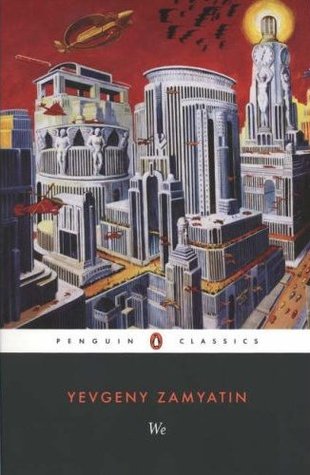
We

Title: We
Author: Yevgeny Zamyatin
Translator: Clarence Brown
Pages: 230 (ebook)
Published: 1921
Published by: ENC Press


The first dystopia ever, it started asking uncomfortable questions about individuals, collectives, revolutions, progress — and the collectives’ rights to individuals’ souls in the name of revolutions and progress.

Digit D-503 is a proud and happy citizen of the United Nation, where people live in identical glass houses and think identical transparent thoughts, equal among themselves and equally happy to be cogs in the machine of the most perfect society that ever existed on earth. The designer of the Integral, the United Nation’s first spaceship, meant to carry “mathematically error-free” happiness to other forms of intelligent life “possibly still existing in the primitive state of freedom,” D-503 is a True Believer in the path of the United Nation until he is mugged by reality that comes in the guise of love for a beautiful, cynical woman who rejects state-sponsored happiness and delights in leading a rebellion.

Yet the rebels’ only virtue is their rejection of the authority of the Do-Gooder, the annually unanimously reelected leader of the United Nation. Their revolution is but for its own sake, and their attitude toward “human slivers” is just as utilitarian as that of the United Nation: to either group, an individual life’s worth is measured only by its usefulness to the cause.


In this, the first dystopian novel and the influence for so many great others, the reader follows D-503. He is one among a collective, doing as he is told and as is set out for him, question nothing and perfectly content in his same-ness. He is the architect of the Integral, the first spaceship, designed to begin to take this perfect, regimented, organised way of life to the rest of the universe. It is only when he meets the captivating I-330 that he begins to stray from the way set out for him and realise that it might not be as perfect as he had previously thought. We are reading his journal, something he intends to be taken on the Integral as an educational tool for those civilisations they meet and 'educate'.

Written in 1921, this is a truly revolutionary book, and you can see its influence on many other books out there, 1984 particularly springing to mind with the regimented schedule and institute of watchful agents. The world created is one that is believable, and numerous times D- states how much better their world is than ours, how misguided we were thinking that things like democracy and personal freedoms made our lives better. How integrated people are, and how some people eventually begin to rebel, are both well done, and I particularly liked was the struggle that D- went through. He didn't just jump on board with the rebellion, there was true personal struggle and realistically human indecision and fear of the unknown. He is, after all, someone who has been one of many for all his life and never really had to think for himself or make any real decision.

There are a small core of characters, but it is only really three that you get any sense of feeling for: D-503, I-330 and O-90, she being D-'s lover at the start of the story. Others flit in and out, but you never really get to know them, and even these three there's a limit to how much you get to know them in that the regimented nature of their lives limits their ability to actually develop into individuals as much as they would have done otherwise. Even the rebellious I- is only really different in her rebellion: she does things because she's not supposed to; you don't really get the feeling she's doing things she likes. D- is clearly very intelligent and seems like a nice enough character, but as the narrator you don't get to see him that much, even if he is rather perceptive when it comes to others.

O-90 is possibly the character I was most attached to. She doesn't get huge amounts of page time, but she seems the most human of the characters we meet. The emotional journey she goes through is wonderfully evocative, and totally relatable. You can't help but feel for her and everything she goes through in the course of the story.

The story itself wasn't particularly gripping, but it was interesting seeing this world and how it's been put together, especially the 'vote' for the Do-Gooder, the unanimously re-elected leader of the United Nations (I pretty much always misread this, and had to go back to prevent confusion, minor though the difference is). It was a slow build, and the climax wasn't particularly climactic, but I still enjoyed the story and the changes D-503 and the United Nation goes through, for all that goes on does have a lasting impact. And the end, too, was realistic and an outcome that - given what you know of the system - makes sense.

An easily recommendable book, both for its own merits and as a look at the beginning of a genre which is coming more and more to the fore.


Friday, 1 March 2013

The Count of Monte Cristo

Title: The Count of Monte Cristo
Author: Alexandre Dumas
Pages: 1264 (paperback)
Published: 2008 (first published 1844)
Published by: HarperPerennial

The ultimate story of escape to riches, revenge and redemption by 'the Napoleon of storytellers'. Falsely accused of treason, Edmond Dantes is arrested on his wedding night and imprisoned in the grim island fortress of Chateau d'If. After staging a dramatic escape he sets out to discover the fabulous treasure on the island of Monte Cristo and uses it to exact revenge on those responsible for his incarceration. The sensational narrative of intrigue, betrayal, escape and triumphant revenge moves at a cracking pace. Dumas' novels present a powerful conflict between good and evil embodied in an epic saga of rich diversity that is complicated by the hero's ultimate discomfort with the hubristic implications of his own actions. A novel of enormous tension and excitement, The Count of Monte Cristo is also a tale of obsession and revenge, with Dantes, believing himself to be an Angel of Providence, pursuing his vengeance to the bitter end before realising that he himself is a victim of fate.

Edmond Dantes is a happy-go-lucky sailor, devoted to his father, and engaged to and deeply in love with the beautiful fisher girl Mercedes. He seems to have it all and therein lies his problem, for when jealous rivals find an opportunity they collude to bring about his downfall. Unfortunate circumstances and deplorable choices from many involved result in Edmond being imprisoned unjustly and thrown into the dungeons of the Chateau d'If. He befriends a fellow prisoner, allowing him to escape fourteen years later an educated man and with the secret to a treasure buried on the small, uninhabited island of Monte Cristo. With his millions (and millions. And millions.) secured he sets out on his revenge of those who betrayed him.

This book has three distinct parts: pre-imprisonment, imprisonment and post-imprisonment. Pre-imprisonment is a good introduction to all the characters, especially Dantes who is just a lovely guy. Pretty much everyone likes him and he's happy living a simple life as long as he can support himself and his father and marry Mercedes.

During his imprisonment you see him harden and change. He goes through believable cycles of hope and despair, even going so far as trying to starve himself at one point. Escape and the return to those he loves is the one thought in his mind for most of the fourteen years of his imprisonment, even when he is befriended by the Abbe Faria, who is quite clearly a 'good guy'. There is very little ambiguity between the good guys and the bad guys: there are those who've helped Dantes and those who've not. I suppose this sort of ambiguity is something that's come more into more modern literature, but it made a nice change to know who you could trust and who you weren't supposed to like. The Abbe sets out to pass on his vast wealth of knowledge, and Dantes proves an apt pupil. It is also the Abbe who passes on the secret of a vast fortune he has discovered.

While these two sections are very good, they are basically quite a long pre-amble section which is giving the tools for Monsieur le Comte de Monte Cristo to get his revenge. Though for all this they are probably some of my favourite parts, possibly because they are very easy to read.

We rejoin the story nine years after Dantes' escape, and his transformation into the Count of Monte Cristo is complete. He is well established in society, has furthered his education and established a coterie of servants (and slaves) about him. And this is where the fun begins. You know who he's going to go after, but he sets in motion these incredibly complex events to try and bring about their downfall without the least suspicion falling on him, and while you know this is what he is doing at the start it is very difficult to see how his actions will lead to this. I think this is even more impressive when you consider that this was published as a serial: there could be no going back and changing things to make it work better when (if) hiccups came along in the plot. Dumas just had to keep writing!

One thing I particularly like is that not everything goes to plan. Things go wrong with what the Count planned through information he doesn't know (though he does seem to know pretty much everything), unexpected relationship and pleas. But similarly there are some lucky coincidences that make things easier. At least I think they were coincidences...you never quite know with the Count. He could just be that good. Which is actually one thing that's a little annoying - he is amazing at, like, everything. He's intelligent and articulate, a master marksman and sword fighter, he can converse in multiple languages without the trace of an accent, has an incredible knowledge of chemistry, is a master reader and manipulator of people, and seems to be quite handsome too. I think music is the only thing that he doesn't excel in, but I'm making this assumption based on the fact that he doesn't partake in any musical demonstrations rather than through anything which said he was bad at it.

And then there's the characters. In the 23 years between his imprisonment and his arrival in Paris to gain his revenge (isn't it lucky they all live in the same city now?) they've got married and had children and lost spouses and remarried and had more children who are now engaged to people (sometimes each other). There are an awful lot of names thrown at you in quite a short space of time, and an awful lot of relationships established. I found it quite confusing at first, and still had blank moments towards the end of the book, having to work hard at who someone's father was, what he'd done to Dantes and how his downfall was being brought about. And it was at this point that my reading of the book fell off for a week or so.

I'd loved the in prison and escape chapters, and while it was necessary for the skip-forward, I struggled a little to get back into the swing of things, especially that the central character was no longer such. There are quite significant sections where he makes no appearance, and for me Dantes/Monte Cristo is the best part of the story. For all his being annoying being-good-at-everything-ness.

The end of the story, though, is rather wonderful. Seeing the consequences of some of his actions shocks the Count into change, and there is a happy ending for some (though nowhere near all) of the characters, often in spite of the actions taken by Monte Cristo. The ending - sailing away into the sunset - was a little cliched, but it was a nice end to a rather amazing book.

Though a little dry in places, the story is amazing and generally easy to read. It might take a while, but I'd definitely recommend it.


Friday, 1 February 2013

Crime and Punishment

Title: Crime and Punishment
Author: Fyodor Dostoyevsky
Translator: David McDuff
Pages: 671
Published: December 31st 2002 (first published 1866)
Published by: Penguin Classics


'Crime? What crime?...My killing a loathsome, harmful louse, a filthy old moneylender woman...and you call that a crime?'


Raskolnikov, a destitute and desperate former student, wanders through the slums of St Petersburg and commits a random murder without remorse or regret. He imagines himself to be a great man, a Napoleon: acting for a higher purpose beyond conventional moral law. But as he embarks on a dangerous game of cat and mouse with a suspicious police investigator, Raskolnikov is pursued by the growing voice of his conscience and finds the noose of his own guilt tightening around his neck. Only Sonya, a downtrodden prostitute, can offer the chance of redemption.


Rodion Romanovich Raskolnikov was studying Law in St. Petersburg, but we join him in the dark days after this. He is impoverished, unable to pay his rent, with a fiancee who has passed away. He doesn't really care about any of this, oftentimes finding it difficult to leave his coffin-like room. His mind in this time wanders, and he decides that if he could just get himself back on his feet he would be able to change hundreds of lives. Surely that makes one, little murder acceptable...? In the tale that follows, we see him commit the act and attempt to deal with the consequences.

This is my first foray into Russian literature, and I've got to say it wasn't anywhere near as bad as I was expecting. Not bad like 'bad', but bad like hard; I don't really know why, but I have it in my head that Russian literature tends to be quite dense. Maybe I've just picked an easy one to start off with! Because this is quite an easy read. You get caught up in the conversations going on, or in Raskolnikov's thoughts. And it's interesting as a reverse crime story. Rather than following the intrepid detective trying to track down the brutal killer, you follow the slightly unstable first-time killer as he tries to hide what he has done from those in authority.

Unfortunately, there isn't huge amounts of action in this book; most of it is conversation-based apart from the odd scene here and there - most notably the murder scene. In fact, I can't actually recall any other ones off the top of my head. People have conversations that last for hours, and thought processes that must take nearly as long. But through this you do get a real feel for the central characters.

And because of how much time you spend with Raskolnikov and in his head, I can honestly say I don't really like him. Now you're probably not meant to, because for all he has these odd bursts of altruism he is still a murderer. And a little bit crazy in some parts of the book. He spends a fair amount of the story in a delirium, using this as a pretty understandable excuse for his actions. He claims confusion or illness as the main cause for many of his actions, often not remembering (or claiming not to) things that have taken place, or why he did the things he did. Although, he does really want to help people, doing things which endanger himself or worsen his already dire financial situation without thought for himself. At least at the time.

Razumikhin is a fellow ex-student, and someone who almost stumbles into friendship with Raskolnikov. He is a deeply caring character, always wanting to help people and putting himself out of his way to ease the suffering of others. Sonya is a prostitute whom Raskolnikov forms a bond with, though the nature of this and how it came about I'm a little unclear about. It didn't really make much sense to be, and while you're told that Sonya is a deeply compassionate person, you're told this more than shown it in any particular way. I didn't think there was all that much too her as a character, especially compared to the depth with which Raskolnikov is shown to have.

Half-way through the book, I could see the story going one of two ways: either he would be found out as a result of some misstep caused by his loose hold on sanity, or he would succeed in getting away with his crime and be driven mad by the weight of the guilt. But I didn't know which was it was going to go, whether he would get away with it or not. There were lots of twists and turns within the crime part of the story which made it enjoyable because you never know from which direction something is going to come next. I was happy with the way that part of the story turned out, though I don't think the epilogue (indeed, the first epilogue I've seen with two chapters!) added much to the story. The first chapter of it was nice as a little round up, but I think I would have preferred it ending there, though I don't know what it is that I don't like about the second chapter. It provides a somewhat necessary final conclusion, though hints at a follow-up on some of the surviving characters which doesn't seem to exist.

An interesting book which I enjoyed a more than I was expecting to.


Friday, 30 November 2012

I Am Legend

Title: I Am Legend
Author: Richard Matheson
Pages: 162 (paperback)
Published: 1954
Published by: Orion Publishing Group

Robert Neville has witnessed the end of the world. The world's population has been obliterated by a vampire virus, though Neville has somehow survived. As he toils to make sense of it all and protect himself against the hounding vampires who seek out his life force, Neville embarks on a series of projects to discover the source of the plague and hopefully put an end to the vampires.


First things first: this is nothing like the film. At all. They've taken the very very basic plot premise and done with it what they wanted. And the central character's name: Robert Neville. Pretty much everything else is different. The ending in particular, but I'm just going to ignore that.

Now, I love the film. Will Smith is one of the few actors who can pull off that amount of screen time alone. But he isn't really the Robert Neville we meet at the start of the story. True, he is more like the man he grows into, but even then there are differences.

Robert Neville at the start of the book is a broken man. Living alone, surrounded by vampires determined to drink his blood every night. His humanity is clear, and his flawed nature. He cares for his teeth rigorously because he is his own dentist, yet he drinks and smokes copiously. He fastidiously cares about his car, yet sometimes goes days without repairing his house from the damage caused by nightly attacks.

We see him surviving and nothing more. Indeed, barely that at times.

But things happen which make him start thinking again. There are quite a lot of biological terms and stuff thrown around in some parts which I won't even pretend to have followed a lot of the time (biology not being my strong point), but it was interesting watching him develop an interest in something.

The conclusions he come to are different and intriguing, and there is a rather amazing twist at the end which is something different from anything I've ever read before. This book is a 'Masterworks' without a doubt.


Friday, 21 September 2012

Little Dorrit

Title: Little Dorrit
Author: Charles Dickens
Pages: 848 (paperback, with some extra stuff at the beginning and end)
Published: April 1st 2009; originally published 1885-1857
Published by: Vintage Classics

Amy Dorrit’s father is not very good with money. She was born in the Marshalsea debtors’ prison and has lived there with her family for all of her twenty-two years, only leaving during the day to work as a seamstress for the forbidding Mrs. Clennam. But Amy’s fortunes are about to change: the arrival of Mrs. Clennam’s son Arthur, back from working in China, heralds the beginning of stunning revelations not just about Amy but also about Arthur himself.

Amy Dorrit lives with her father in a debtors prison, hiding the fact that she works for their living and that her older brother and sister work (or attempt to) to support themselves. He is something of a broken man, once prosperous but now without a penny to his name and dismayed by this fact. Then Arthur Clennam returns from working with his now-deceased father in China and finds her working for his mother. His interest is piqued...and he's not the only one. Soon, an unexpected revelation vastly changes the fortunes of the family. All of this takes place on the backdrop of Victorian England, and with the usual array of slightly mad characters seen in Dickens novels.

So, the BBC did an adaptation of this a few years ago, and I watched it maybe 18 months ago. Now the BBC is pretty good at this kind of thing (Pride and Prejudice with Colin Firth, anyone?) and I really enjoyed it. Of course, I'd never read the book so I didn't have anything to compare it to, but still. I liked the characters and the story, and it was very easy to watch.

Maybe it's because I already knew the story - so minimising the suspense of 'what's going on? What's going to happen?' - but I struggled a little to keep going whilst reading it. Part of this may be due to Dickens' writing style. There is quite a lot of description and lists and lists of whatever is going on around the characters: food stuffs, things they can see, what people are wearing etc. There is also quite a lot of superfluous description in general, and chapters relatively regularly started with pages and pages of description of where they were based. Yes, this is good in some ways, but in a book this long it becomes a bit difficult after a while.

I've not read much Dickens, but in this book he did something I'd never come across before. Most of the time, we would follow characters around and their actions would be narrated in the standard fashion. Speech in speech marks and all that. But this time, for one character it was more written from the point of an invisible presence or something. People's actions were described, and it was said that they made comments about one thing or another, but the actual interactions weren't really given. I'm sure there's a technical term for it but I don't know it. Now, I didn't like this, and luckily it only occurred in a minority of chapters, but I still didn't like it.

The characters themselves were wonderful, many of them complete with their own little annoying quirks (you know you all have your own!) and you got a real feel for them and to grow to care about (or dislike, as appropriate) many of them. Little Amy Dorrit is sweet and self-sacrificing, always doing what she can for others before thinking of herself. She cares for her father immensely, and does everything she allowed to for him. Her older brother and sister - though her brother isn't really present all that much - are quite the opposite. They think only of themselves and how to achieve their own ends, though Edward doesn't seem to have quite the same capabilities when in comes to succeeding in this as Fanny does. There is also Amy's uncle, and seeing their relationship in particular is lovely, as you get the feeling that he is the only one who truly understands and appreciates all she does, whatever their circumstance in life.

There were a number of quite amusing secondary characters who had their own roles to play, and the Circumlocution Office (a branch of the government which works towards perfecting how to not do things) is a wonderful parody of the government system even now. I suppose something never change!

The story, though long, is quite interesting. There is a good deal of mystery surrounding a couple of people, their actions and motives, and while some things come as a complete surprise, you can work out a couple of things.

Interesting story with good characters, but there was maybe just a little bit too much extra stuff around it all.


Sunday, 1 April 2012

The Woman in White

Title: The Woman in White
Author: Wilkie Collins
Pages: 672 (paperback)
Published: April 29th 2003 (first published 1859)
Published by: Penguin Classics


‘In one moment, every drop of blood in my body was brought to a stop… There, as if it had that moment sprung out of the earth…stood the figure of a solitary Woman, dressed from head to foot in white’

The Woman in White famously opens with Walter Hartright’s eerie encounter of a moonlit London road. Engaged as a drawing master to the beautiful Laura Fairlie, Walter becomes embroiled in the sinister intrigues of Sir Percival Glyde and his ‘charming’ friend Count Fosco, who has a taste for white mice, vanilla bonbons and poison. Pursuing questions of identity and insanity along the paths and corridors of the English country houses and the madhouse, The Woman in White is the first and most influential of the Victorian genre that combined Gothic horror with psychological realism.

Walter Hartright is a drawing master working in London when he is employed to work in Cumberland for three months, repairing the collection of paintings in Limmeridge House for the owner, Mr. Fairlie, and instructing the two young women who reside there in watercolours. The night before his departure he runs into Anne Catherick just outside of London in the middle of the night. This meeting is to throw him into a mystery which had its beginning decades before and which impacts the lives of many people in different ways.

This, in essence, is a detective story. The narrative as we read it has been compiled by Hartright with the testimonies of the people best able to relate the events which took place. We see them in chronological order, I think making it somewhat easier for the reader to work out what might be going on (though some key ones are left out of this order, instead related in Hartright's narrative as he finds things out by talking to people) than for those embroiled in the plot.

And quite a plot it is. There are twists and turns and things going wrong all over the spot. My first instinct of 'oh, well this is obviously what happened' turned out to be completely wrong, and while there were a couple of instances where I worked out what had happened, for the most part I was completely in the dark as to what was really going on. Which is exactly what you want from this kind of story - you want to be trying to work it out and getting it wrong, or at least parts of it. The point of the detective story is to show off the prowess and tenacity of the investigator and it loses something if it is too easily solvable.

To be fair, Hartright had more tenacity than prowess - he is so desperate to solve the mystery that he stops at nothing and you know he would not give up until every possibility had been thoroughly investigated. He is a great character, if a little overdescriptive at times in his narratives. But being an artist, this is maybe to be expected and actually shows his character coming out in his writing. Of the other contributors to the narratives my favourite has to be Count Fosco - he is a wonderfully eccentric and flamboyant character, while also quite clearly being something of a genius, particularly when it comes to human nature. Even before he had his say and he was merely appearing in other reports he was my favourite character. Especially because you're never quite sure what his motives are or whether you can trust him or not. Mr. Fairlie - the owner of Limmeridge House - was also quite amusing in his complaints. Think Mrs. Bennett from Pride and Prejudice, only more.

There were a couple of mildly creepy moments, but not as much as I was expecting given that it was described as part-Gothic horror. Yes, sensibilities have changed a lot in the last 150 years, but I was still expecting a little more. On top of this, the story did drag at times and I didn't find it the easiest book in the world to read. Still, it was definitely enjoyable and makes you want to find out what has happened and what the cause of the whole thing was. Everything is tied up nicely and nothing of significance was left unanswered - even if some of it was only conjecture on the part of Hartright.


Saturday, 24 March 2012

Canterbury Tales

Title: Canterbury Tales
Author: Geoffrey Chaucer
Translated by: David Wright
Pages: 482 (paperback)
Published: May 15th 2008 (first published 1390)
Published by: Oxford University Press

Chaucer's most celebrated work, The Canterbury Tales (c.1387), in which a group of pilgrims entertain each other with stories on the road to Canterbury, is a masterpiece of narration, description, and character portrayal. The tellers and the tales are as fresh and vivid today as they were six centuries ago.


One night, Chaucer finds himself in a pub. He meets a load of other people going to Canterbury, so decides to join them. To make the journey a bit more interesting, the owner of the pub sets them a challenge: to each tell at least one story on the trip to Canterbury and back to the pub; with him joining them to be the judge, the winner gets a meal paid for by all the others.


This leads to a wide range of tales from the wide range of people who make up this group of pilgrims, and the tales they tell are by turn amusing, entertaining, heartbreaking, educational and (though only a couple) tedious. The majority had some sort of moral to them, which can still be applied to today a lot of the time. Most of them are very good, but some few I found to be a little on the dull side,The Monk's Tale being the one that particularly stood out for me in this regard, it being merely a recounting of all the men through history who had succeeded but then been brought low through one thing or another. Luckily it was quite short so it wasn't too bad.


Particularly of note for me were:
The Knight's Tale, which was long but lovely and showing how much impact one person can have on the lives of others. The phrase which came to mind while reading it was 'bros before hoes'.
The Reeve's Tale was really quite amusing, in spite of it being a little crude.
The Prioress's Tale was absolutely heart-breaking but still a wonderful story. I didn't the consequences coming and they were shocking and so incredibly sad.
The Oxford Scholar's Tale was also sad, but in a very different way. I felt incredibly sorry for the poor woman and everything her husband put her through: it seemed petty and without real need. If I was her I could not have managed to put up with anything near what she did, and I don't doubt everyone else would say the same.


The voices of the tale-tellers were all quite distinct, though I think the host was my favourite character - a pity, then, that he has only a very little input - usually breaking up disagreements between the travellers. Not only the stories themselves, but the form and vocabulary seemed to fit each person wonderfully. The descriptions in all quite light, leaving it up to the imagination of the reader for the most part, which I think was clever. Beauty - in people or place - is very much subjective and so when the beautiful girl was introduced in each story (for there was one in nearly all of them) their physical attributes were left to the imagination.


I have to commend the translation, because when starting out I was worried I would struggle terribly with it, but it is wonderfully done and I found very easy to read and understand. It wasn't all fancy or unnecessarily wordy or anything annoying like that, and I genuinely enjoyed reading the majority of it, skipping through the stories (particularly the earlier ones) at quite a pace.