Saturday, 5 January 2013

Watching the English

Title: Watching the English: The Hidden Rules of English Behaviour
Author: Kate Fox
Pages: 432 (paperback)
Published: April 11th 2005
Published by: Hodder and Stoughton


In "Watching The English" anthropologist Kate Fox takes a revealing look at the quirks, habits and foibles of the English people. She puts the English national character under her anthropological microscope, and finds a strange and fascinating culture, governed by complex sets of unspoken rules and byzantine codes of behaviour. The rules of weather-speak. The ironic-gnome rule. The reflex apology rule. The paranoid-pantomime rule. Class indicators and class anxiety tests. The money-talk taboo and many more ...


Through a mixture of anthropological analysis and her own unorthodox experiments (using herself as a reluctant guinea-pig), Kate Fox discovers what these unwritten behaviour codes tell us about Englishness.


Starting off, I loved this book. It was generally well-written, easy to read, insightful and funny. Yes, I was mainly laughing at all the things I recognised that I did myself, but it was still funny. These were things I didn't even really notice, or rather didn't realise were peculiarly English (I almost wrote British there, but the book is exclusively about the English!The Scots, Welsh and Irish would probably hate to be lumped in with us). The topics were interesting and easy to relate to - things you see all the time and think nothing off. It's just the way you, or others act; it's the norm. I can't imagine how hard it must have been for Fox to remove herself from her own culture and get inside of it.

But then the chapters started getting longer. And longer.

And the time it took me to read each one got longer. And longer.

Even though each chapter has subsections (often very similar ones), it is still rather disheartening to have been reading for half an hour and still only be half-way through a 50-page chapter. I think this book would have benefited from being broken down into more bite-sized chunks. The early chapters were easy to wizz through in a sitting, and I enjoyed them a lot more like that.

There was also rather a lot of repetition. I understand that she's looking for the commonalities of English-ness in various aspects of everyday life and therefore the same things will keep cropping up, but 'social dis-ease' and 'props and facilitators' came up so often it began to annoy me a little. Similarly when it came to class and the endless lists and repetitions of what the lower/lower-middle/middle-middle/upper-middle/upper class would do in each circumstance, call each thing. Towards the end even the author made a joke about how often these had been referenced, and couldn't we work it out for ourselves by now?

In all honesty I skipped over the conclusion section. I'd read the little summary at the end of each chapter and figured this would just be a general gathering of everything said there. I scanned and skipped bits, but nothing more. Because I couldn't be bothered reading the same things all over again.

This book was quite interesting in places, but could have been written more concisely I think. Being English, I appreciated it, but I doubt people from other nationalities would unless they had spent a lot of time in England or around the English.


----
Some of my favourite quotes from the book:

"Formality is embarrassing. But then, informality is embarrassing. Everything is embarrassing." (p. 41)

"If you are socially skilled, or come from a country where these matters are handled in a more reasonable, straightforward manner (such as anywhere else on the planet), you may need a bit of practice to achieve the required degree of embarrassed, stilted incompetence." (p. 52)

"English men can turn almost any conversation, on any topic, into a Mine's Better Than Yours game." (p. 55)

"[T]he English...can spot the slightest hint of self-importance at twenty paces, even on a grainy television picture and in a language we don't understand." (p. 63)

"When waiting alone for a bus or at a taxi stop, I do not just lounge about anywhere roughly within striking distance of the stop, as people do in other countries - I stand directly under the sign, facing in the correct direction, exactly as though I were at the head of a queue. I form an orderly queue of one." (p. 91)

"I would suggest that home is what the English have instead of social skills." (p. 134)

"The opportunity to moan or, even better, the opportunity to indulge in some witty moaning, is irresistible." (p. 143)

"...when any inadvertent, undesired contact occurs (and to the English, almost any contact is by definition undesired), we say 'sorry'." (p. 150)

"We huff and puff and scowl and mutter and seethe with righteous indignation, but only rarely do we actually speak up and tell the jumper to go to the back of the queue." (p. 154)

"Moderation is all very well, but only in moderation." (p. 195)

"...the English take great pleasure in being shocked and outraged, and righteous indignation is one of our favourite national pastimes" (p.196)

"The English are human; we are social animals just like all other humans, but we have to trick ourselves into social interaction and bonding by disguising it as something else" (p. 241)

"The English are not keen on random, unstructured, spontaneous, street-corner sociability; we are no good at this, and it makes us uneasy. We prefer to socialize in an organised, ordered manner, at specific times and places of our choosing, with rules that we can argue about, an agenda, minutes and a monthly newsletter." (p. 250-251)

"Even an Anarchist meeting I attended followed the same sequence, although it was much better organized than most, and at the demonstration the next day the members were all dressed in uniform black, carrying professional looking banners, chanting in unison and marching in step." (p. 252-253)

"...our obnoxiousnesses are about as awkward, irrational and inelegant as our politenesses." (p. 265)

"'I get the impression,' said one frustrated American, 'that at some deep-down, fundamental level the English just don't really expect things to work properly" (p. 303) *We don't. It's more surprising when things go right than when they go wrong.

"At funerals we are left bereft and helpless. No irony! No mockery! No teasing! No banter! No humorous understatement! No jokey wordplay or double entendres! How the hell are we supposed to communicate?" (p. 375)

Friday, 28 December 2012

Feed

Title: Feed
Series: Newsflesh #1
Author: Mira Grant
Pages: 571 (paperback)
Published: May 1st 2010
Published by: Orbit

The year was 2014. We had cured cancer. We had beaten the common cold. But in doing so we created something new, something terrible that no one could stop. The infection spread, virus blocks taking over bodies and minds with one, unstoppable command: FEED. Now, twenty years after the Rising, bloggers Georgia and Shaun Mason are on the trail of the biggest story of their lives - the dark conspiracy behind the infected. The truth will get out, even if it kills them.


Zombies came and there was chaos. Then people got over it and began trying to live their lives again. It was bloggers that spread the word of the original uprising, and this medium has taken over much of the media. Georgia and Shaun Mason are two such bloggers who, along with Georgette "Buffy" Meissonier, win a place on the campaign trail of Peter Ryman. They thinks it's going to be the launching pad their career needed, but there's so much more going on than they know...and there are still all those zombies out there too!

This book is a light, humorous look at America trying to carry on with a normal life 20 years after two miracle cures - for the common cold and cancer - join forces, mutate and cause the Rising: zombies. For obvious reasons, the story and humour both were sometimes a little dark, but it was a nice twist on the normal zombie story.

The story focuses on bloggers - who've taken the place of televised journalists - Georgia and Shaun Mason and Buffy Meissonier as they go on the campaign trail. The characters are likeable and most have their moments of brilliance, though it gets a little annoying that we are constantly reminded that Shaun likes to 'poke dead things with a stick' and that Georgia has retinal KA. In the case of the latter I understand that it is a significant, and annoying, part of her life but it seems like we can't go two pages without being reminded of this fact.

George does make a good narrator, if she does over explain things at times; this may be cleverly done and be based in her journalistic roots, but there is an awful lot of showing rather than telling which makes me think it's more the author coming through than George herself. The little snippets taken from other characters' blogs were good, and each did have their own distinctive voice.

The story as a whole was intriguing and very few clues were given as to what was actually going on, keeping you guessing until the characters themselves find out. This was nice in that I was saved being exasperated at the sheer stupidity of characters not realising what was going on when it has been made clear enough for to the reader to work it out, but a little frustrating in that I didn't think there weren't really enough clues to tell you that something was going on until it was revealed. You think it's just going to be about zombies and stuff, and then it's all like *BOOM* now there's this going on too! I would have liked a bit more of a precursor.

This book was a pretty solid 3 stars for most of it. This is, until we reach the end.

The ending made this book for me. There were a couple of twists in the story prior to this point, but the peak of this story was brilliant for it's emotion rather than for its cleverness or inventiveness. A good story was made better by the sheer emotiveness of the writing and, for that reason, I've had to bump it up to 4 stars.


Saturday, 22 December 2012

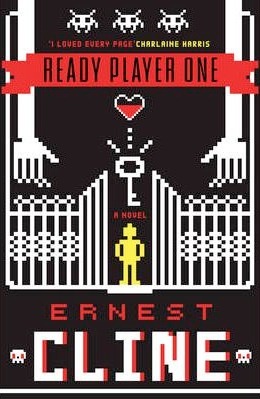
Ready Player One

Title: Ready Player One
Author: Ernest Cline
Pages: 374 (paperback)
Published: August 18th 2011
Published by: Crown Publishers.


It's the year 2044, and the real world is an ugly place. 

Like most of humanity, Wade Watts escapes his grim surroundings by spending his waking hours jacked into the OASIS, a sprawling virtual utopia that lets you be anything you want to be, a place where you can live and play and fall in love on any of ten thousand planets. 
And like most of humanity, Wade dreams of being the one to discover the ultimate lottery ticket that lies concealed within this virtual world. For somewhere inside this giant networked playground, OASIS creator James Halliday has hidden a series of fiendish puzzles that will yield massive fortune--and remarkable power--to whoever can unlock them. 
For years, millions have struggled fruitlessly to attain this prize, knowing only that Halliday's riddles are based in the pop culture he loved--that of the late twentieth century. And for years, millions have found in this quest another means of escape, retreating into happy, obsessive study of Halliday's icons. Like many of his contemporaries, Wade is as comfortable debating the finer points of John Hughes's oeuvre, playing Pac-Man, or reciting Devo lyrics as he is scrounging power to run his OASIS rig. 
And then Wade stumbles upon the first puzzle. 
Suddenly the whole world is watching, and thousands of competitors join the hunt--among them certain powerful players who are willing to commit very real murder to beat Wade to this prize. Now the only way for Wade to survive and preserve everything he knows is to" win." But to do so, he may have to leave behind his oh-so-perfect virtual existence and face up to life--and love--in the real world he's always been so desperate to escape. 
A world at stake.
A quest for the ultimate prize.
Are you ready?


Wade lives in a digital world, spending the huge majority of his time escaping into the virtual reality of Mass Multiplayer Online Role-Playing Game OASIS. He goes to school there, and he spends almost all his spare time looking for the answer to the first clue to a treasure hunt left by the creator of OASIS. The one which will means whoever reaches the end inherits his fortune.

I was very much looking forward to this book. The premise is different, and it intrigued me for this reason. Humanity spends much of its time jacked into OASIS - a MMORPG of massive, world-wide proportions. People have more a life in the digital world than they do in reality. And who can blame them?

You can be whoever you want to be, and travel to any fantasy world that has been built. Upon reading that this included Middle Earth and Discworld among others I instantly found myself fervently wishing that it was actually possible because that would be beyond cool. I loved all the geeky references throughout the book, though I'm not really into video games so a lot of those passed me by. Still, I loved when I recognised a reference. But most of the television and music references were based in the 80s and while I was born in the 80s, I didn't grow up in them so almost all of that passed me by. I think I would have enjoyed this book so much more if it was taking me back to my youth in a way it probably does for slightly older readers.

The characters were all nice enough, but I never really got attached to them. This may be because I never felt they were ever really in any danger because most of the action takes places with their OASIS avatars rather than the people themselves. The central character in particular - Wade/Parzival - never really clicked with me and often I ended up liking the people he interacted with more than I liked him. Something just fell a bit flat, possibly because his whole life was OASIS and this isn't something I can relate to. While this is true for the other characters too, them not being POV characters lessens the effect somewhat I think: you don't see the way this (what basically amounts to) addiction does to them in the same way as you do him.

I loved the first section of the book, with it zipping along at a nice enough pace to keep you reading. However, in the second and third the pace slows a little to build the story somewhat. It was still an easy read, and I was interested enough to want to know what was going to happen, but something not quite tangible just wasn't present for me. The ending was very well done, though there was never really much tension for me - it always seemed like a foregone conclusion so I was never really worried about what was going to happen to any of the characters or what the ending was going to be. Regardless of this fact, I wanted to know how the ending was reached and enjoyed the ride getting there.

A fun read which I'm sure will be incredibly nostalgia-inducing for many people.


Friday, 14 December 2012

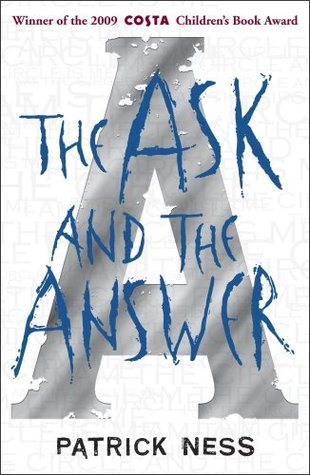
The Ask and the Answer

Title: The Ask and the Answer
Series: Chaos Walking #2
Author: Patrick Ness
Pages: 517 (paperback)
Published: 2011
Published by: Walker Books


Fleeing before a relentless army, Todd has carried a desperately wounded Viola right into the hands of their worst enemy, Mayor Prentiss. 
Immediately separated from Viola and imprisoned, Todd is forced to learn the ways of the Mayor's new order. 
But what secrets are hiding just outside of town? And where is Viola? Is she even still alive? And who are the mysterious Answer? 
And then, one day, the bombs begin to explode...
This second thrilling volume in the Chaos Walking trilogy is a tense, shocking and deeply moving novel about resistance under the most extreme pressure.


Todd and Viola spent The Knife of Never Letting Go racing to reach Haven, hoping there to find refuge from the men of Prentiss Town, Todd's home, and the army issuing from there. But the end of their journey was just one disaster after another, and nothing turned out the way they were hoping. Now, they're in New Prentiss Town, each trapped by the promise of the other. In the last book we saw their relationship develop, and now we're seeing this being used against them.

This book had a very different feel than the last, and was in fact a lot easier for me to read. The last one was all from Todd's point of view, whereas here we also follow Viola's story as we follow the story of the two predominant groups emerging in New Prentiss town: the Ask, and the Answer. Each is fighting for what they believe in and each believes their is the best way, the only way, the world can work. Attacks are made, people are killed, and lies are told.

Though this is still definitely a kid's book, there are some darker themes than the first in the series with racism (against the Spackle - the native species of the colonised planet) and terrorism both quite heavily prevalent in this book. In fact, it was probably this maturation between the two that made it easier for me to read. Running away from a murderous army looking to take over the world isn't something I can really relate to, but racism and terrorism - unfortunately - are things we see far too much of. On top of this, there isn't as much 'noise' (the people of the planet being infected with a virus which makes them able to hear each others thoughts) featured, just making it easier for me not to get distracted by things go on on the next page or whatever.

Neither Todd nor Viola seemed to particularly change over the course of the book; rather, their presence impacts those around them, be it for better or for worse. Davy Prentiss Jr. is the most notable example of this, Todd's presence significantly impacting his life in a way I did not see coming at all. Because this is the first time we've seen them develop relationships that lasted more than a few hours, given the nature of the last book when they were constantly on the move. It was nice seeing them interact with new people consistently, and there are some relationships I'm intrigued to follow and see where they go.

There were some major events going on at the end of the story, and even more than the last one we're left with a cliff-hanger. I'm looking forward to the resolution of the story, and seeing where Todd and Viola end up.