Friday, 22 February 2013

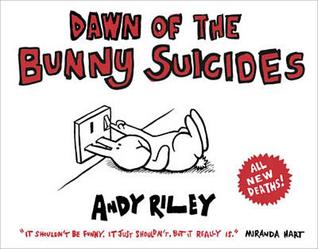
Dawn of the Bunny Suicides

Title: Dawn of the Bunny Suicides
Series: Books of the Bunny Suicides #3
Author: Andy Riley
Pages: 160 (paperback)
Published: December 3rd 2010
Published by: Hodder & Staughton


From the author of the cult bestsellers THE BOOK OF BUNNY SUICIDES and RETURN OF THE BUNNY SUICIDES comes another unmissable collection of rabbit-related self destruction...


The bunnies are back - and there's only one thing on their minds. In this new collection, follow the continuing adventures of the fluffy little rabbits who just don't want to live any more...


So, I know this isn't a real book really, but the book I was planning on reviewing this week I haven't actually quite finished - The Count of Monte Cristo, 1228 pages down, 36 to go! - so I'm cheating a little bit. Plus, this is a great book in it's own way! It's funny and inventive, and a little sad a times. The bunnies are pretty darn cute, and you can't help feel sorry for them.

While you laugh at some of the ways they think up of killing themselves off, of course.

There are many pop culture references in there too, with Harry Potter, Indiana Jones and James Bond all making appearances as accidental accomplices in the sometimes potentially quite messy deaths.

Even my grandparents found it funny! They were rather confused when I showed it to them, not really understanding why anyone would want a book about rabbits committing suicide, but they too were soon laughing at many of the cartoons.

A nice, quick, incredibly entertaining read collection of cartoons for your perusal!


Friday, 8 February 2013

Battle Royale

Title: Battle Royale
Author: Koushun Takami
Translator: Yugi Oniki
Pages: 617 (paperback)
Published: February 26th 2003 (originally published 1999)
Published by: VIZ, LLC

Koushun Takami's notorious high-octane thriller is based on an irresistible premise: a class of junior high school students is taken to a deserted island where, as part of a ruthless authoritarian program, they are provided arms and forced to kill one another until only one survivor is left standing. Criticized as violent exploitation when first published in Japan - where it then proceeded to become a runaway bestseller - Battle Royale is a Lord of the Flies for the 21st century, a potent allegory of what it means to be young and (barely) alive in a dog-eat-dog world. Made into a controversial hit movie of the same name, Battle Royale is already a contemporary Japanese pulp classic, now available for the first time in the English language.


A class of school children and put on a island and told to kill each other off until there is only one person left alive: it's kill or be killed. They are each given a weapon, ranging from incredibly useful (a machine gun) to completely useless (a fork). How do you trust people in this situation? Even those you've been friends with for you whole life?

Whilst this isn't a book I think I'll ever read again I'm so glad I have read it once, because I was almost put off by the level of violence I was told was in it. This is a violent book, and sometimes a little unnecessarily so, but not to the level I was expecting from what I'd heard. I'm quite a squeamish person and there were a couple of bits that I struggled with but it wasn't too bad for the most part.

This was my first foray into Japanese literature and the style was a little unusual in places and I found myself actually laughing, somewhat inappropriately I'm sure, at some of the things in the narration. I also had trouble keeping track of who was who because I'm unfamiliar with the names and some of them were so similar, which I'm sure took something from the story. I'd be there trying to figure out who was who when two people ran into each other which was a little distracting at times but more a reflection of my inability than an actual criticism of the book.

As a psychology student, I found this book incredibly interesting as a study of human nature and how different people react in extremem situations. Obviously there are some who take to it like a fish to water; those who do what they need to simply to survive; and those who simply refuse to partake: the whole range is covered in this book in a great way. Confusion, fear and mistrust reign on the island, and make for a riveting read. People are second-guessing themselves and those they think they know and whole relationships fall apart right in front of your eyes, whilst others stand the test.There were also moments which were absolutely heart-breaking when tearful goodbyes were made.

Relatedly, the number of characters who claimed to love one of the others was just ridiculous! This may be a cultural thing which I'm missing, but it seemed like ever other person was in love with someone and for me that cheapened the emotion a little because I didn't believe it: they are only 15 and declarations of love are being made all over the spot. It seemed like a device to make the events more harrowing rather than a realistic reflection of that age group. One of the characters does wonder whether the situation is the cause of this which is possible, but so many seem to have been in love with the other person before 'The Program' began that I'm not sure of this.

The ending was a little obvious, though having said this there were genuinely incredibly tense times where I actually questioned whether I was right in my prediction which was wonderful. So often you never feel that the main characters are never in any real amount of danger; not so in this book, and for good reason!

Overall an amazing, fast-paced book that keeps you guessing and hoping and reading right to the very end.

Friday, 1 February 2013

Crime and Punishment

Title: Crime and Punishment
Author: Fyodor Dostoyevsky
Translator: David McDuff
Pages: 671
Published: December 31st 2002 (first published 1866)
Published by: Penguin Classics


'Crime? What crime?...My killing a loathsome, harmful louse, a filthy old moneylender woman...and you call that a crime?'


Raskolnikov, a destitute and desperate former student, wanders through the slums of St Petersburg and commits a random murder without remorse or regret. He imagines himself to be a great man, a Napoleon: acting for a higher purpose beyond conventional moral law. But as he embarks on a dangerous game of cat and mouse with a suspicious police investigator, Raskolnikov is pursued by the growing voice of his conscience and finds the noose of his own guilt tightening around his neck. Only Sonya, a downtrodden prostitute, can offer the chance of redemption.


Rodion Romanovich Raskolnikov was studying Law in St. Petersburg, but we join him in the dark days after this. He is impoverished, unable to pay his rent, with a fiancee who has passed away. He doesn't really care about any of this, oftentimes finding it difficult to leave his coffin-like room. His mind in this time wanders, and he decides that if he could just get himself back on his feet he would be able to change hundreds of lives. Surely that makes one, little murder acceptable...? In the tale that follows, we see him commit the act and attempt to deal with the consequences.

This is my first foray into Russian literature, and I've got to say it wasn't anywhere near as bad as I was expecting. Not bad like 'bad', but bad like hard; I don't really know why, but I have it in my head that Russian literature tends to be quite dense. Maybe I've just picked an easy one to start off with! Because this is quite an easy read. You get caught up in the conversations going on, or in Raskolnikov's thoughts. And it's interesting as a reverse crime story. Rather than following the intrepid detective trying to track down the brutal killer, you follow the slightly unstable first-time killer as he tries to hide what he has done from those in authority.

Unfortunately, there isn't huge amounts of action in this book; most of it is conversation-based apart from the odd scene here and there - most notably the murder scene. In fact, I can't actually recall any other ones off the top of my head. People have conversations that last for hours, and thought processes that must take nearly as long. But through this you do get a real feel for the central characters.

And because of how much time you spend with Raskolnikov and in his head, I can honestly say I don't really like him. Now you're probably not meant to, because for all he has these odd bursts of altruism he is still a murderer. And a little bit crazy in some parts of the book. He spends a fair amount of the story in a delirium, using this as a pretty understandable excuse for his actions. He claims confusion or illness as the main cause for many of his actions, often not remembering (or claiming not to) things that have taken place, or why he did the things he did. Although, he does really want to help people, doing things which endanger himself or worsen his already dire financial situation without thought for himself. At least at the time.

Razumikhin is a fellow ex-student, and someone who almost stumbles into friendship with Raskolnikov. He is a deeply caring character, always wanting to help people and putting himself out of his way to ease the suffering of others. Sonya is a prostitute whom Raskolnikov forms a bond with, though the nature of this and how it came about I'm a little unclear about. It didn't really make much sense to be, and while you're told that Sonya is a deeply compassionate person, you're told this more than shown it in any particular way. I didn't think there was all that much too her as a character, especially compared to the depth with which Raskolnikov is shown to have.

Half-way through the book, I could see the story going one of two ways: either he would be found out as a result of some misstep caused by his loose hold on sanity, or he would succeed in getting away with his crime and be driven mad by the weight of the guilt. But I didn't know which was it was going to go, whether he would get away with it or not. There were lots of twists and turns within the crime part of the story which made it enjoyable because you never know from which direction something is going to come next. I was happy with the way that part of the story turned out, though I don't think the epilogue (indeed, the first epilogue I've seen with two chapters!) added much to the story. The first chapter of it was nice as a little round up, but I think I would have preferred it ending there, though I don't know what it is that I don't like about the second chapter. It provides a somewhat necessary final conclusion, though hints at a follow-up on some of the surviving characters which doesn't seem to exist.

An interesting book which I enjoyed a more than I was expecting to.

Friday, 25 January 2013

The Crow

Title: The Crow
Series: The Chronicles of Pellinor #3
Author: Alison Croggon
Pages: 528 (paperback)
Published: July 3rd 2006
Published by: Walker Books

Whilst his sister, Maerad, pursues her dangerous destiny in the frozen North, Hem is sent south to Turbansk for his own safety. But soon the forces of the Dark overrun the great city and Hem flees with his mentor, Saliman, his white crow, Irc, and a young orphan girl, Zelika, to join the resistance. He agrees to help fight the Nameless One by spying on the child armies of the Dark. Now Hem has a vision—he too has a part to play in Maerad’s quest for the Treesong. But Zelika has been captured by the child army, and Hem’s destiny must wait. Hem pursues Zelika to the Dark’s stronghold, little realizing that her cause is lost. He reunites with Saliman and, broken-hearted, starts the perilous search for his sister.

In The Gift, Maerad found her brother, only to have him cruelly torn away by their need to escape a terrible danger. In The Crow, we join Hem several months later and follow his journey as he grows into himself and his abilities through terrible times.

So in all honesty, this is probably my least favourite book in this series, and that's because we leave behind Mearad and Cadvan and go across the other end of Annar to follow Hem and Saliman instead. This has probably skewed my opinion somewhat because while the story related in this book is important, I didn't want to be reading it. I wanted to be reading about Maerad. We've spent two books following her and getting to know her, and then suddenly she's not there are all. But I'm aware this is probably more personal taste than anything else.

The story is quite slow in places: there's quite a lot of waiting about for things to happen, both for the reader and for the characters. This is in part the nature of the story as the city is under siege, but it felt like while the previous books had long periods of riding around this one had long periods of waiting, and it is a lot easier for other stuff to happen while your characters are riding around than when they are waiting.

Hem grows a lot in the course of the book, both physically (as we are reminded a number of times) and within himself. He grows in confidence as he helps those around him and finds his own strengths, which was nice to see. When we first meet him in The Gift, he is a broken little boy who struggles trusting people. By the end of this book he has matured and overcome some of his demons, relying entirely on his own abilities and what he feels is the right thing to do. He grows close to a number of people (and one crow - hence the name of the book) and it was nice seeing his healing.

This book also shows us more of the country of Annar and the Seven Kingdoms, although I suppose it's more specifically Suderain - one of the Seven Kingdoms. This is in the far south of the country, and is far removed from the other cities both in terms of distance and culture. And this is another reminder about how much thought and effort has gone into creating this world and its many different facets, different cultures.

This book is also quite a lot darker than the previous two. There's death and despair, which have always been present in the others but more as an allusion or being passed through rather than actually being present and experienced. You can't help but feel sorry for Hem and all he has to go through, and all the other characters who find themselves fighting for their survival and losing so much - their homes, friends families.

A good book, that quite possibly deserves a higher rating that what I'm giving it but I just didn't really feel it. It doesn't entrance me the way the others do in this series.